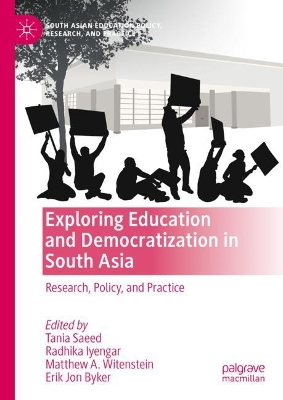
This volume brings together scholars, practitioners, activists, and students to reflect on socio-political transitions taking place in countries across South Asia and their implications for democracy and education. It provides an important intervention for comparative education in South Asia by looking at the kind of ideological tensions that exist within the education systems, and how these competing agendas are visible at different levels. At a time when students have been protesting for their rights across educational institutions in South Asia, where the Covid-19 pandemic has exacerbated inequalities with learning losses, and job losses, this collection creates a space to reflect on the limitations and possibilities of education in democracies across South Asia.
1 Introduction.- 2 Illuminating the Shadow Education Mechanism
of Neoliberal Governmentality in Bangladesh.- 3 Competition Exams and Topper
Praise in India: A Media Case Study in Educational (In)equality.- 4 Populist
Visions and the Issue of Exclusion: An Exploration of Educational Policy
Reforms in India and Pakistan.- 5 Missing Girls on the Margins? Equity,
Assessment, and Evaluation in Indias New Education Policy.- 6 Unregulated
Private Tutoring in India: Educational Inequalities Engendered by the Light
But Tight National Education Policy 2020.- 7 Federalism in Nepal: Early
Implications for School Governance.- 8 Higher Education Reforms: Unfulfilled
Promise of Decentralization in India.- 9 Neoliberal Politics of Education
Reforms in India: A Case of De Facto Privatization in University of
Delhi Through NEP 2020.- 10 Sites of Struggle as Sites of Learning: Student
Activism as Counter-Hegemonic Resistance to the Neoliberal University in
Pakistan.- 11 Mobilizing for Justice: Social Media as a Transformational Tool
for Student Activism in Pakistan.- 12 Democracy and a Quality Education in
South Asia: A Conclusion.
Tania Saeed is Associate Professor of Sociology in the Mushtaq Ahmad Gurmani School of Humanities and Social Sciences at the Lahore University of Management Sciences (LUMS), Pakistan.
Radhika Iyengar is Associate Research Scholar at the Center for Sustainable Development at the Earth Institute, Columbia University, USA.
Matthew A. Witenstein is Assistant Professor in the Department of Educational Administration at University of Dayton, USA.
Erik Jon Byker is a Full Professor in the Cato College of Education and Honors College at the University of North Carolina at Charlotte, USA.

 Biežāk uzdotie jautājumi par e-grāmatām