Atjaunināt sīkdatņu piekrišanu

Global and Regional Climate Interaction: The Caspian Sea Experience Softcover reprint of the original 1st ed. 1994 [Mīkstie vāki]

  • Formāts: Paperback / softback, 243 pages, height x width: 235x155 mm, weight: 454 g, VII, 243 p., 1 Paperback / softback
  • Sērija : Water Science and Technology Library 11
  • Izdošanas datums: 10-Oct-2012
  • Izdevniecība: Springer
  • ISBN-10: 9401044686
  • ISBN-13: 9789401044684
Citas grāmatas par šo tēmu:
  • Mīkstie vāki
  • Cena: 91,53 €*
  • * ši ir gala cena, t.i., netiek piemērotas nekādas papildus atlaides
  • Standarta cena: 107,69 €
  • Ietaupiet 15%
  • Grāmatu piegādes laiks ir 3-4 nedēļas, ja grāmata ir uz vietas izdevniecības noliktavā. Ja izdevējam nepieciešams publicēt jaunu tirāžu, grāmatas piegāde var aizkavēties.
  • Daudzums:
  • Ielikt grozā
  • Piegādes laiks - 4-6 nedēļas
  • Pievienot vēlmju sarakstam
  • Formāts: Paperback / softback, 243 pages, height x width: 235x155 mm, weight: 454 g, VII, 243 p., 1 Paperback / softback
  • Sērija : Water Science and Technology Library 11
  • Izdošanas datums: 10-Oct-2012
  • Izdevniecība: Springer
  • ISBN-10: 9401044686
  • ISBN-13: 9789401044684
Citas grāmatas par šo tēmu:
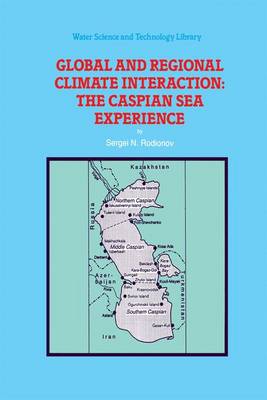
The Caspian Sea is the world's largest inland body of water both in area and volume. Its drainage area is approximately 3. 5 million square kilometers, extending 2500 km in length, 35°N to 600N, and on average 1000 km wide, 400E 0 to 60E (Fig. 1). Located in a large continental depression about 27 m below sea level and with no surface outlets, the Caspian Sea is particularly sensitive to climatic variations. As with other closed-basin lakes, its level depends on the balance between precipitation and evaporation, which is directly linked to atmospheric circulation. Because of its large area and volume of water, the Caspian Sea effectively. filters climatic noise, and as such may serve as a good indicator of climatic changes through observed changes in its water level. Recently, the Caspian Sea has come under increased attention from physical and social scientists owing to its unique natural characteristics as well as the' very important role it plays in the ecoriomil:!s of such countries as Azerbaijan" Russia, Kazakhstan, Turkmenistan and Iran. Dissolution of the Soviet Union and creation of new independent states resulted in difficult negotiations to divide the wealth of the Caspian Sea and to establish new economic zones. According to one assessment (Ratkovich, 1988), the Caspian Sea basin accounted for about one-third of the total economic output, one-fifth of the agricultural production, and one-third of the hydroelectric production of the former Soviet Union.

Papildus informācija

Springer Book Archives
1 Introduction.- 2 Seasonal and Longer-Term Changes of Climatic
Characteristics in the Caspian Sea Basin.- 2.1 General climate
characteristics.- 2.2 Long-term changes in the seasonal cycle.- 2.3
Interannual and longer-term changes.- 2.4 Temporal changes in the frequency
structure.- 3 The Caspian Sea and Climatic Processes in the Northern
Hemisphere.- 3.1 Teleconnections.- 3.2 Atmospheric circulation patterns
during a rise and decline in the CSL.- 3.3 The role of the North Atlantic.-
3.4 The extraordinary rise in the CSL after 1977.- 3.5 Climate and CSL
changes during the past millennium.- 4 Forecasting the Caspian Sea Level.-
4.1 Causes of the CSL fluctuations.- 4.2 Comparative analysis of
climatological methods.- 4.3 Instability of correlation relationships.- 4.4
An approach based on probabilistic logic.- 4.5 Experimental results.- 5
Caspian Sea Level and Anticipated Global Warming.- 5.1 Global climate
modelling.- 5.2 Paleoclimate analogues.- 5.3 Climate of the 1980s and early
1990s.- Concluding Remarks.- Appendix Fortran-Program for Constructing a
Linkage Tree.- References.